
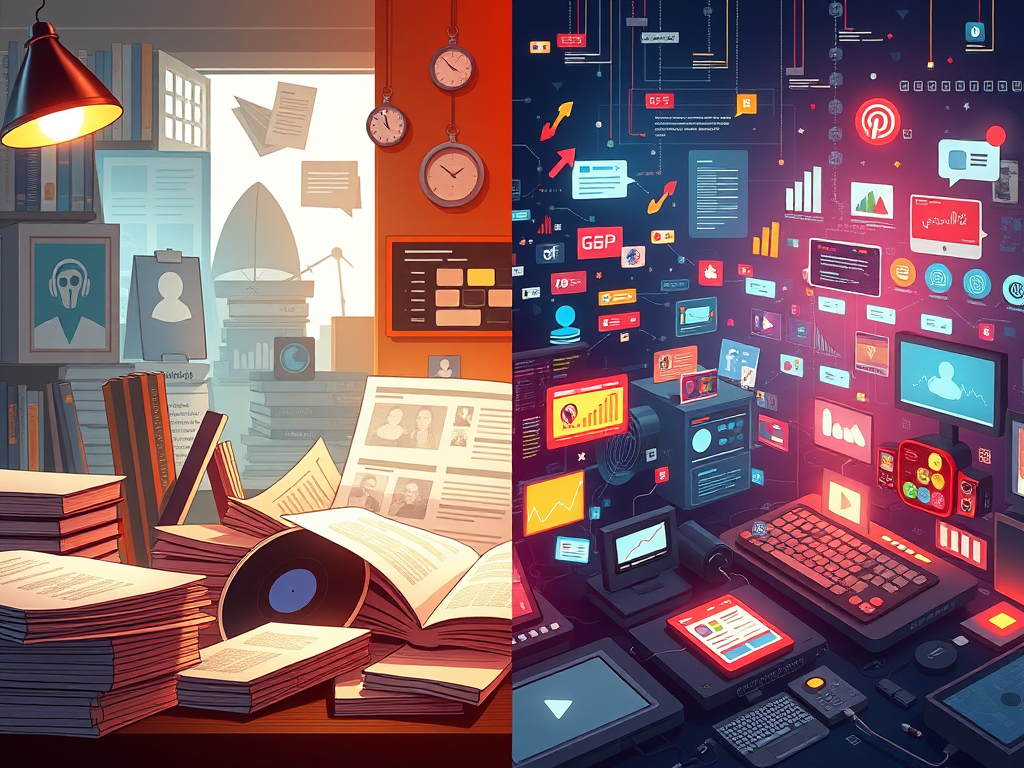
The Internet we were promised is not the one we ended up with. Instead of being the long tail out of Mass Media monoculture, we ended up with a surveillance economy where bots and algorithms compel our clicks and engagement in return for “free” content. The race for engagement has pushed humanity down a dark path of rage-bait, polarization, and addiction.
How did we get here, and how can we get out?
Mass Media
In the beginning, mass media were broadcasts. Someone would create a book, a song, or a TV show and distribute it. People would tune it to their shows. They would select books and purchase albums. Accessing was an active decision. The closest you could get to “push” media was newspapers and magazines, which would run a set of curated articles — but readers still selected which periodicals they were interested in.
Web Pages

When the Web launched in 1991, it was mostly a curiosity. There was little reason for corporations to have a website. Most sites were academic, a club or hobby group, or one of the thousands of personal homepages and fan pages.
Human beings would create and post content. Before search engines, people navigated between sites by joining “web rings,” where like-minded web pages would link to each other, or by directory sites where dedicated humans would maintain lists of sites by topics.
But behind each website was a human “web master” who was responsible for their little corner of the Internet.
Along Came The Advertising
Initially, the World Wide Web didn’t change much. Unable to handle video and music, the early web was well-suited for newspapers and magazines. Companies looked to expand their existing subscription market. In the world before online shopping, online banking, and apps; people were not used to handing over payment information to a website.
You’re The Product
Advertising became the primary means of funding digital content. Had subscriptions won, today we would be looking at a very different Internet. In a subscription model, the subscriber is the customer. In the advertising model, the audience is the product, and the customers who call the shots are the ones who are paying to influence you.
You are Tracked
The Internet is unique in that it is two-way communication. As advertisers tell you about their messages, you are telling them about you. They track your habits, locations, sites you visit, apps you use. They track where you go, what you consume, what interests you, and what get’s a reaction out of you.
For the first time, advertisers were not broadcasting to broad audiences; they were able to talk to each consumer directly.
Personalization Is Manipulation
Internet people often talk about “personalization” as a benefit to consumers. We can recommend content that will interest you. We can target you with products you cannot resist.
However, we can also tailor the content to your needs. If you and I visit the same news site, we will likely see different headlines. If we go to the same Google search, we will see different results. Your social streams might be driving engagement by showing you news stories that outrage you while mine is trying to “activate” me with appeals to sign petitions about my personal hot button topics.
Even though we are on the same sites, we are getting different answers.
Dead Internet

The Dead Internet theory posits that a majority of what you see and read on the Internet is generated by bots rather than humans.
Low-quality content farms like eHow and Quora would spin out 1000s of pages a day to spam their way to the top of your search results.
Shady bots and troll farms sell their services to act like humans online. They give bad products good reviews, post misinformation on social media, and leave comments on content to legitimize falsehoods or drown out voices.
With the rise of AI-generated content, we don’t even need humans. Already we are seeing articles written by AI that cite other fake articles written by AI, becoming a self-referential circle of reaffirming nonsense.
Fast Media
We are no longer living in the broadcast area. We are living with Fast Media:
- Powers the Attention Marketplace
- Designed to be addictive
- Makes humans the product
- Designed to influence you and your worldview
Fast Media is an advertising product that sells your attention to advertisers. Fast media tracks you and sells your personal details. Fast media helps advertisers find you and build the messages that will best influence you.
Advertisers are not simply stores trying to get you to buy their products. They are political parties trying to sway your vote. They are foreign governments seeking to undermine your country. They are special interests who want to change how they relate to the world.
Fast media will show you likes and comments. Fast media will be that quick break from boredom and that doomscroll as you procrastinate. Fast media is habit-forming.
Fast media will tear apart your family to get you to commit to a political party. Fast media will convince you that your neighbors are trying to replace your way of life to create violence in the streets.
The Attention Market
Americans spend an estimated $3000 to $6000 on media: your internet services, streaming, video games, movies, etc. While that seems like a lot, it is dwarfed by how much advertisers are spending to reach you as you consume digital media!
46% of streaming subscriptions are ad-supported, and 74% of TV viewing time is ad-supported. While Americans spent $57 billion on digital media in 2024, advertisers spent $259 billion on digital advertising.
Advertisers will pay 5x more for your digital attention than you will for digital content!
Sustainable Media
Fast media isn’t sustainable. But it isn’t the only, or even the inevitable, option.
The original web pages, newspapers, Tumblr, blogs, and photo galleries are all still out there. There is still a lot of human content made for humans; it’s just not being advertised to you.
We need a sustainable media movement. We should look at how other sustainable movements have come from fast markets.
Fast Markets
The “sustainable” or “slow” consumer movement has emerged as a response to the negative consequences of the “fast” markets enabled by mass production. Mass production created cheaper options. Companies competed with each other by choice, convenience, and price over quality. Consider items like fast food and fast fashion.
Eating out was an expensive luxury, and home-cooked meals were time and labor-intensive. Fast food created dining options that everyone could afford. McDonald’s stopped bragging about how many billions of burgers they served after surpassing 99 billion in 1993. Ready made meals and packaged food helped at-home dinners cut out the work and save time.
Clothing used to be much more expensive. Items were repaired, handed down, and worn for years. In 1900, a person might spend 14% of their income and own 20 garments. In 2022, you might own 100 garments and have only spent 2-3% of your income! Whereas your grandmother’s dress might still have plenty of wear in it, no one is fixing their acrylic H&M sweaters.
Mass production has created new and more affordable choices, but it has also incurred far-reaching social and personal costs. Fast food is often high in fat, sugar, and salt, contributing to a surge in health issues among Americans. The industrial agri-culture practices that fuel cheap meat and sugary corn syrup have wreaked havoc on the environment and family farms. Fast fashion has become a significant environmental issue, from the highly toxic manufacturing processes to the proliferation of disposable clothing filling our landfills.
Sustainable Markets



As consumers became more aware of the negative impacts of their shopping habits, companies began selling locally sourced, organic, and made from recycled materials, as well as artisanal and homemade products.
Many of these claims were merely marketing additions to labels with little substance behind them. Consumers demanded trusted verification of which companies and products were actually more sustainable and which were just “green washing.” Governments and independent third-party programs were created to cut through the false claims and to simplify the various labeling schemes used by different companies.
Sustainable markets won’t replace fast mass markets. Mass production has improved the lives of many, and not everyone can afford to make the sustainable choice all the time. Sustainable markets offer alternatives. Consumers can opt for higher-quality items that will last longer and can be repaired, healthier foods, products that will offer more benefits to their community, or products with fewer negative impacts on the planet.
Most importantly, consumers can make an informed choice. No longer can soda makers pass off sugary drinks as a healthy option for growing children, or McDonald’s proudly launching paper straws that turned out to be non-recyclable.
Sustainable Media Manifesto

The organic food movement didn’t succeed by writing manifestos. It succeeded by creating a label, a set of verifiable, independently certified criteria that let consumers make an informed choice without having to audit every farm themselves. We need the same thing for media.
Not a vague editorial promise. Not a “we take accuracy seriously” footer. A certification. Something you can point to and say: this outlet either meets these criteria or it doesn’t.
Sustainable media is media whose business model aligns the incentives of creators, platforms, and audiences without relying on addiction, surveillance, or manipulation.
The Sustainable Media Criteria
I. Transparent Ownership Who owns this outlet is public knowledge. Ownership changes are disclosed. No hidden beneficial owners.
II. Independent Editorial Editorial decisions are made without advertiser approval or interference. Advertisers cannot kill or shape stories. Sponsorships are clearly labeled and cannot influence coverage.
III. Separated Opinion and Fact Opinion, analysis, and factual reporting are clearly distinguished. Entertainment is not presented as news. The publication does not use editorial framing to mislead readers about the nature of content.
IV. Verifiable Claims Factual claims are sourced and checkable. Corrections are published prominently. The outlet does not knowingly publish misinformation.
V. Non-Addictive Design The product is not designed to exploit psychological vulnerabilities. No infinite scroll designed to override conscious choice. No engagement-maximizing algorithms that prioritize outrage. No dark patterns.
VI. No Covert Surveillance Reader data is collected only with informed consent, for the purpose of delivering the service. Data is not sold to third parties. Behavioral profiling for advertising is disclosed and opt-in.
VII. Fair Creator Compensation The people who create the content are compensated fairly. The outlet does not rely on unpaid labor, content farms, or AI-generated content passed off as human.
VIII. Human Editorial Accountability There is a named human editor accountable for editorial standards. AI-generated or assisted content is disclosed. There is a clear process for readers to challenge content.
These are not utopian demands. Every one of them is measurable. Organic food certification handles supply chains across hundreds of countries — certifying whether a news outlet discloses its ownership is not a harder problem. What’s been missing is the will to demand it, and the infrastructure to verify it.
The original web had something Fast Media will never have: a human being behind every page, responsible for what they put there. Sustainable Media is just the project of getting back to that accountability, at scale.